Thanks for stopping by A Family Place. I enjoy working with families, and sharing the power of music with them. Kindermusik provides this outlet for me. This blog will allow me to share thoughts and ideas that can help families in their journey.

Wednesday, July 29, 2009

Listening to Music, Part 3

I previously admitted that I don't listen to much music, not by electronic means anyway.  Most of the music I listen to is music that I make, students are learning, or other live performances. Despite my lack of  listening, I do believe that listening to music has many benefits.  

In a recent article in Scientific American renowned neurologist Oliver Sacks of Columbia University had this to say concerning music, “Certainly music seems to be the most direct form of emotional communication.  It really seems to be as important a part of human life and communication as language and gesture.”  Emerging evidence also indicates that music brings out predictable responses across cultures and among people of widely varying musical or cognitive abilities. Even newborn infants and people who cannot discern pitch enjoy music’s emotional effect. 

When I was pregnant with my first child I was also in graduate school studying piano pedagogy. One of the pieces that I was working on in my private lessons was Nocturne in B Major, Op. 32, No. 1 by Chopin.  I would spend hours at the piano -  practicing, refining and memorizing this beautiful composition.  I never really considered the effects of all of this music on my unborn child until several months later.  My son, Aaron was a fussy baby.  We did many things to quiet and calm him.  One night after much exasperation I suggested that my husband bring him downstairs in my piano studio.  As he held this squirming and screaming infant, I began to play the Nocturne.   After only a few measures, Aaron became very quiet and gazed up knowingly at his father.  It was as if he was saying "this is my music".  It was at that point I realized the power of music. 

Wednesday, July 15, 2009

Listening to Music, part 2

I admitted that I don't do a lot of "leisure" listening.  In fact, I prefer silence to background sounds.  My kids are used to it, but they do think it is weird.  They probably prefer "no music" to the talk radio they get with their dad, but that is another story!

Though I'm not a listener in my down time, I do believe listening to be beneficial.  Just as children learn to talk because their environment is filled with words, music can be learned in the same way.  Shinichi Suzuki developed his music education philosophy based on "Japanese children learn to speak Japanese".  The premise is that children learn based on the environment in which they live.   He taught that children who listened to music could learn to be musicians. 

In a nutshell, here is the Suzuki philosophy:  A child and his mother would come for a violin lesson. The child is taught by rote, and the mother also.  When the child goes home, the mother is the teacher.  The mother makes sure the child practices daily, and that there is a time for listening each day too. The child would listen to recordings of the songs he is learning on the violin. The listening might occur during the meal, rest time, or while the child is playing.  Thus the environment is saturated with music.  The child that learns in this way develops a sense of musicianship before he is encumbered with reading the music.   The lay term that is often used is, "he has a good ear".

Kindermusik has a similar philosophy.  The classroom is filled with music, and activities that promote steady beat, vocal expression, exploration and improvisation of sounds.  When the families leave the Kindermusik class, they take CD's home that allow them to saturate their environment with the same songs they enjoyed with the group.  When the children are between 4 1/2 - 7 years old they are introduced to the notes, rhythm and terminology they have already experienced.
Does this transfer to learning songs?  YES!  
The children have it in their body, because they have moved to the song. The children have it in their voice, because they have sung the song.  

In my next post I will share the benefits of music listening through a few personal stories.


Monday, July 13, 2009

Listening to Music

As a musician, I admit to listening to very little music.  I know that seems strange, but let me explain.  Most people have music playing in their car, and in their house.  The majority of the time this is just filler...background music.  Nothing wrong with it.  In fact, society promotes it.  Elevator music, music while we shop, music while we are 'on hold', commercials and tv shows with music.  I get a lot of strange looks, and comments when I tell people that I don't listen to music.  They usually think I am kidding.   

Music is my job.  I have to listen to it, right?  Yes, but even my leisure listening is with a definitive purpose.  I turn on Copland, and really listen to the motifs that occur throughout his symphonic works.  I listen to Bach, and enjoy the polyphonic texture he created with elegance and proficiency.  David Holt sings a folk song, and I listen to the instrumentation as it compliments the text.  At church I listen to the blend of instruments and voices. During football season I go to hear the band at half-time!

Yes, I sing along when I listen to music.  I will tap my toes, and sometimes conduct the music.  I may not listen the same way as other folks, but I embrace music with my heart, soul & mind.  

Saturday, June 27, 2009

Pictures/video from Orffestrations camp


Here two additional photos, and another video from the 
Orffestrations camp at Berry College.
. 
The video is a speech ensemble.  A poem is about spaghetti, followed by ostinato patterns about slurping and garlic bread, then all three parts are together.  The children really enjoyed this activity, especially the boys as they "slurped".  The children experience different parts simultaneously.  This type of activity is a prelude for 2 and 3 part singing. 

Friday, June 26, 2009

Orff with children


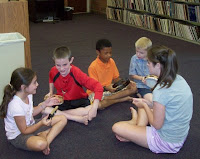
My last post was about Orff-Schulwerk and my training.  I enjoyed two weeks with other music teachers learning more about how to create arrangements for Orff instruments.  This past week I implemented what I learned as I led an Orffestrations camp for children.  This class met for 2 hours each day at Berry College, and included 11 children, ages 7 - 10.
 Most of these children have prior music experience:  Kindermusik, piano or children's choir at church.   We had a wonderful time making music together.  The children enjoyed being together, singing, moving, playing instruments, and were eager to do their best each day.  As I pondered our accomplishments during the week I came up with the following:

1.  cooperation - working together is an important part of making music & a life skill.

2.  listening & critiquing  - was it too loud? did we hear the singing? was it expressive? did we maintain a steady beat? what did we like?

3.  time & space - as we moved through the room we had to be aware of our friends so that we did not bump.   The same concept is needed in the grocery aisle with a buggy!

4. identifying patterns in music - rhythmic and melodic patterns were presented after singing, moving and playing them!  

5.  steady beat - pulse is most important!!

6.  parts - the children were able to layer up to 3 parts.  We did this in speech and playing instruments too.  The children could play a part on their instrument and sing at the same time.

7. vocal expression - we always wanted to use an interesting voice, as if we were telling a story.

Here is a video that will allow you a glimpse of our class.  I'll post another one later.

Saturday, June 6, 2009

What is Orff?

I am taking my level 2 Orff-Schulwerk Certification. I drive to Cobb County every day for two weeks, and meet with over 50 other music educators. It is the highlight of my summer! Why? Because the classes stretch me, and encourage me as a musician, teacher and person. But what is it? Here is a synopsis:


Orff Schulwerk is a "philosophy" of teaching music. It is not a method. It is a way of teaching the entire child, the cognitive as well as the affective domains.

1. Movement is always first.


2. Body percussion. (snap, pat, pat, and stamp)


3. Rhythm instruments and recorders.


4. Pitched percussion instruments are added and integrated into what we know today as Orff Schulwerk.


5. Improvisation and composition are included in an Orff class.


Orff (named for Carl Orff) Schulwerk (German for School work) takes teachers and students into deeper levels of teaching and learning. Going beyond knowledge and comprehension, students apply their knowledge, often independent of the teacher, through composition and improvisation.


Being exposed to this type of learning, and then applying this new information to my teaching is exhilarting. Helping children express themselves through music and movement is why I continue my education through Orff classes.


There is an Orffestrations class for children ages 7 - 10, at Berry College. The class meets June 22 - 26, and there is still space available!

Thursday, May 28, 2009

Summer activities for everyone

Looking for family friendly activities close to home? Then check out Oak Hill at Berry College.


There are movies in the meadows - $10 a carload! You can take a historic bike ride, complete with a guide. There are classes for the children, that include painting flower pots, building a birdhouse, or learning about horticulture. Do you have family coming to town, then take them to the museum at Oak Hill and learn more about Martha Berry. There is so much to do and see at Berry College, and it's right in our own backyard! While your thinking about Berry, check out the Kindermusik classes that are offered this summer too.